
–:– / –:–
This voice experience is generated by AI. Learn more.
This voice experience is generated by AI. Learn more.
Summary
Despite the ease of home entertainment, audiences are increasingly choosing supersized live experiences, driving significant growth in stadium concerts, premium cinemas, and immersive attractions like the Las Vegas Sphere and next-generation theme parks. This surge is fueled by advanced technology creating spectacular, multi-sensory events and a post-pandemic desire for shared physical experiences. Younger generations, in particular, prioritize these memorable, scarce events over abundant digital content, valuing the “I was there” factor and the ability to connect with others. Audiences value unique, physical experiences that create lasting memories, even at premium prices, as digital entertainment becomes ubiquitous.
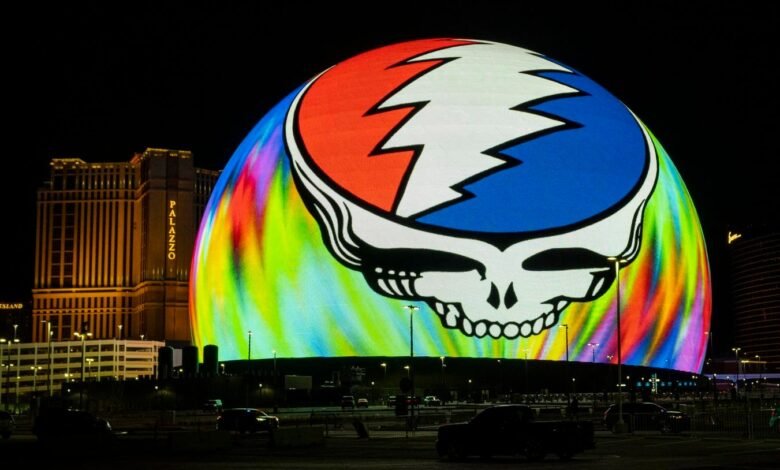
LAS VEGAS, NV – MARCH 19: The Grateful Dead logo, Steal Your Face Skull, is displayed on the Sphere, promoting the Dead & Company’s upcoming Dead Forever residency on March 19, 2024 in Las Vegas, Nevada. The music and entertainment venue has the largest LED screen in the world. (Photo by Kevin Carter/Getty Images)
Entertainment has never been easier to experience from the comfort of your living room, between the proliferation of affordable 4K TVs with theater-quality features and the abundance of streaming. And with the costs of concerts and movies rising, consumers have every motivation to stay home. But audiences are choosing supersized entertainment that pulls them off their sofas and into stadiums, theaters, theme parks, and other immersive attractions.
Stadium concerts averaged 56,272 tickets sold per show in 2025, up 11% from the previous year, even as the average stadium ticket price climbed 18.3% to $216.13. Live Nation venues are on track to host close to 75 million fans in 2026, an increase of more than 10% from 2025. Premium cinema continues to grow in 2026, with ScreenX and 4DX generating a combined $70 million at the domestic box office during the first half of the year, up 26% from 2025.
The ongoing post-Covid-19 return to live entertainment helps explain the rising numbers, which might still be attributed in part to pent-up demand. But five years after vaccines became widely available, the appetite for supersized entertainment also seems driven by forces ranging from evolving technology and the scarcity of physical experiences in a world of unlimited digital content, to our basic desire to experience something alongside other people.
Technology is helping entertainment companies turn the venue itself into part of the show. Giant LED displays, sophisticated projection, immersive audio, automation, digital effects and advances in stage and ride engineering are making experiences possible that would have been difficult to create even a decade ago.
Stadium Concerts Turn Tours Into Theatrical Spectacles
Superstar tours increasingly resemble traveling theatrical productions, made possible by advances in video, lighting, sound and stage design. Lady Gaga’s Mayhem Ball continued into 2026 with a giant Gothic opera-house set, enormous video walls, pyrotechnics, and elaborate choreography. Luke Combs’s 2026 My Kinda Saturday Night Tour uses a massive 360-degree stadium stage with moving lighting trusses and a technically complex production designed to reach fans surrounding him on every side. His March show at Allegiant Stadium drew 70,900 people.
Premium Theaters Break the Boundaries of the 2D Screen
Premium formats push cinema far beyond the traditional 2D frame. IMAX combines enormous screens with specialized cameras and projection; Dolby Cinema adds Dolby Vision and Atmos sound; ScreenX extends images onto the side walls; and 4DX adds moving seats and environmental effects.
Half of the North American opening-weekend audience for Christopher Nolan’s The Odyssey chose a premium large format, including 23% who chose IMAX. Some IMAX 70mm locations sold out midnight and 3 a.m. screenings. Nolan, an influential champion of IMAX technology, worked with IMAX to develop lighter, quieter cameras that allowed him to shoot dialogue and take the cameras to sea in ways that previously would have been much more difficult.
Sphere Redefines Venue Architecture as an Immersive Canvas
The Las Vegas Sphere is a 17,500-seat spherical amphitheater engineered with the world’s highest-resolution wraparound LED interior screen, advanced beamforming audio, and full 4-D physical sensory effects. While The Wizard of Ozis available to watch at home whenever someone wants, more than 3.6 million people have instead gone to Las Vegas to experience the 1939 movie on Sphere’s enormous wraparound interior display, generating roughly $450 million in box office revenue for that production alone. This commercial momentum extends across the business, with Sphere segment revenue reaching $226.4 million in the second quarter of 2026, up 29% year over year. The underlying infrastructure has supported blockbuster concert residencies by acts like U2, Eagles, Dead & Company and Phish, alongside immersive productions such as Darren Aronofsky’s Postcard From Earth. Metallica will bring its own concert production to Sphere later in 2026.
Next-Generation Theme Parks Build Living Worlds
The battle for consumer leisure spending has turned major theme parks into a high-stakes competition over proprietary intellectual property and total immersion. Universal and Disney are locked in an aggressive race to translate studio franchises into physical environments that link film, gaming, music and hospitality into single destinations. Universal’s multibillion-dollar Epic Universe in Orlando anchors this strategy, allowing visitors to step into physical lands built around Nintendo, Harry Potter, How to Train Your Dragonand Universal classic monsters by combining elaborate set design, animatronics, digital projection, and track engineering. Disney has made massive capital commitment across Walt Disney World, including dedicated lands for Avatar and Star Wars that make guests active participants inside its intellectual property.
The financial returns justify the investment. Disney’s Experiences division generated more than $34 billion in revenue in fiscal 2025, continuing to produce the lion’s share of the company’s operating income. Universal Destinations & Experiences delivered record performance, generating more than $9 billion in revenue. The attractions both companies have invested in erase the line between watching a movie, playing a video game, and physically living inside the fictional world.
Technology helps explain how supersized entertainment has become possible. It doesn’t explain why people want so much of it.
One of the enduring lessons from the pandemic is that our entertainment at home may sound and look better than ever, but it cannot supply thousands of other human beings reacting around us.
Events serve as the physical meeting point for global online fandoms. Whether it is the bracelet-trading camaraderie of Taylor Swift’s Eras Tour, the cross-generational pilgrimage of the Oasis reunion, the stadium spectacle of Beyoncé, the high-energy fan communion at Harry Styles and BTS runs, or the fraternity of classic-rock faithful packing arenas for Rush in 2026, live shows function as cultural summits. Audiences are no longer simply buying a local concert ticket. They are acting as gig tourists by booking flights, reserving hotels and building entire multi-day trips around a single stadium date or Las Vegas residency.
Fans anticipate concerts together online, coordinate outfits and travel plans, film and photograph the show, and share it afterward. The physical experience feeds the digital conversation, which makes other people want to experience it for themselves. The smartphone plays both sides of the phenomenon: digital entertainment gives people reasons to seek physical experiences, while social media increases the value of having those experiences. Concerts, Sphere, theme parks and premium movie screenings produce photos, videos and stories people can share.
The generation that grew up with streaming, social media, and smartphones appears particularly interested in getting together in person. According to Deloitte, Gen-Z and Millennials attend nearly every category of live event more frequently than older generations and spend more on concert and sporting-event tickets.
Live Nation’s 2025 Living for Live study surveyed 40,000 people across 15 countries. Ninety-three percent said they attend shows because they crave physical experiences over virtual ones. Seventy-seven percent said the crowd makes them feel part of something bigger. Eighty percent of respondents said they would rather spend money on experiences than possessions. Separate Live Nation research found that 70% of Gen-Z live-music attendees said one of the most memorable moments of their lives occurred at a live music event.
Personalized digital entertainment has given people extraordinary control over what they consume, but it also isolates them in algorithmic bubbles. My Spotify recommendations aren’t yours, and neither is my TikTok feed. Families can sit in the same house watching different entertainment on different screens. Supersized entertainment gives people an occasion to experience the same thing at the same time.
Abundance is one of digital entertainment’s greatest virtues. It can also make individual pieces of entertainment feel disposable. Spotify offers almost any song whenever we want it. Streaming services give us enormous movie and television libraries. YouTube Shorts, Instagram Reels and TikTok deliver quick pulses of entertainment like dopamine. Finish one video and another starts. Stream an album and Spotify automatically segues into another. There is always something else.
Physical entertainment operates under different rules. A stadium contains a finite number of seats. An IMAX 70mm screening happens at a particular theater at a particular time. Seeing a residency at Sphere requires getting to Las Vegas. Scarcity can make the experience feel more valuable.
People bought tickets a year in advance to The Odyssey and showed up for screenings in the middle of the night even though they knew the movie would eventually be available at home. Access to the movie wasn’t scarce, but access to that particular experience was.
The economics of live entertainment increasingly reflect the distinction. The scarcity of physical experiences has helped venues command premium prices as streaming and gaming become ubiquitous. Digital entertainment competes by becoming more accessible. Physical entertainment can become more desirable by remaining scarce.
Consumers can be remarkably price-sensitive about everyday entertainment. Raise the price of a streaming subscription by a few dollars and people reconsider whether they need it. Then someone spends hundreds of dollars on a concert ticket. The purchases serve different purposes.
A streaming subscription supplies entertainment for a month, but a concert or theme park trip can supply memories that endure for years. Live Nation reported that 75% of survey respondents plan their calendars early around concerts, while one in four had gotten a temporary or permanent tattoo commemorating a live-music memory. Digital technology has given us more entertainment than we could ever consume. Perhaps abundance is also making us more willing to pay for the experiences we cannot summon whenever we want them.
Editorial StandardsReprints & Permissions
LOADING VIDEO PLAYER…FORBES’ FEATURED Video
Source: www.forbes.com